Barry Chalmers (Attended 1959–1963)
Published March 2026

From a young age, Barry Chalmers (1959–1963) knew he wasn’t meant for office work like his father. Growing up in Titahi Bay – surrounded by the sea, estuary, and hills – he was drawn to the outdoors. Commuting to Wellington during his final year at Scots College only confirmed that he needed a job that was physical, varied, and connected to nature. When he saw a newspaper advertisement seeking young men for forestry work, he immediately recognised it as the right path.
Forestry proved to be one of the best decisions of his life. The long, physical days offered constant variety, planting, pruning, logging, and gave him a strong sense of purpose. The training laid the foundation for a career he would grow to love.
A major turning point came when he moved to Karamea for further training. The small station provided a wide range of hands-on forestry work, from surveying and roadlining to log scaling, mill studies, firefighting, and track maintenance. It was also where he met May, the local woman who would later become his wife.
After the Forest Service was disbanded, Timberlands West Coast took over large areas of native forest and began exploring less damaging harvesting methods. In 2001, helicopter logging was introduced. His role involved assessing and grading each log, ensuring accurate recording, and checking for waste. The work was demanding and exciting – one of the best jobs he had ever had.
When helicopter logging eventually wound down, he returned home. By then, he had already started assisting with conservation work, particularly bat and kiwi surveys. Soon after, he was asked to lead bat surveys around Karamea. While most of his past work had involved longtailed bats, he made a landmark discovery: nineteen shorttailed bats in the Oparara Basin – the first sighting in over forty years.
This discovery led to fulltime work with the Department of Conservation, where he continued bat research and helped launch the Whio (blue duck) recovery programme. Through extensive trapping and pest control, Whio numbers rose from sixteen birds in 2006 to fifty breeding pairs by the time he left in 2014. Kiwi populations doubled, and even New Zealand’s largest native spider began to stabilise.
Alongside his fieldwork, he cultivated a passion for local history. His first book, The Heaphy and Its People, emerged after discovering century-old names carved into a limestone cave wall. His second book, Karamea: Forgotten Footprints, documented the region’s shipping, flax milling, sawmilling, and Forest Service history. His third, Karamea–Little Wanganui Fire Brigade 1962–2012, chronicled the stories of both brigades.
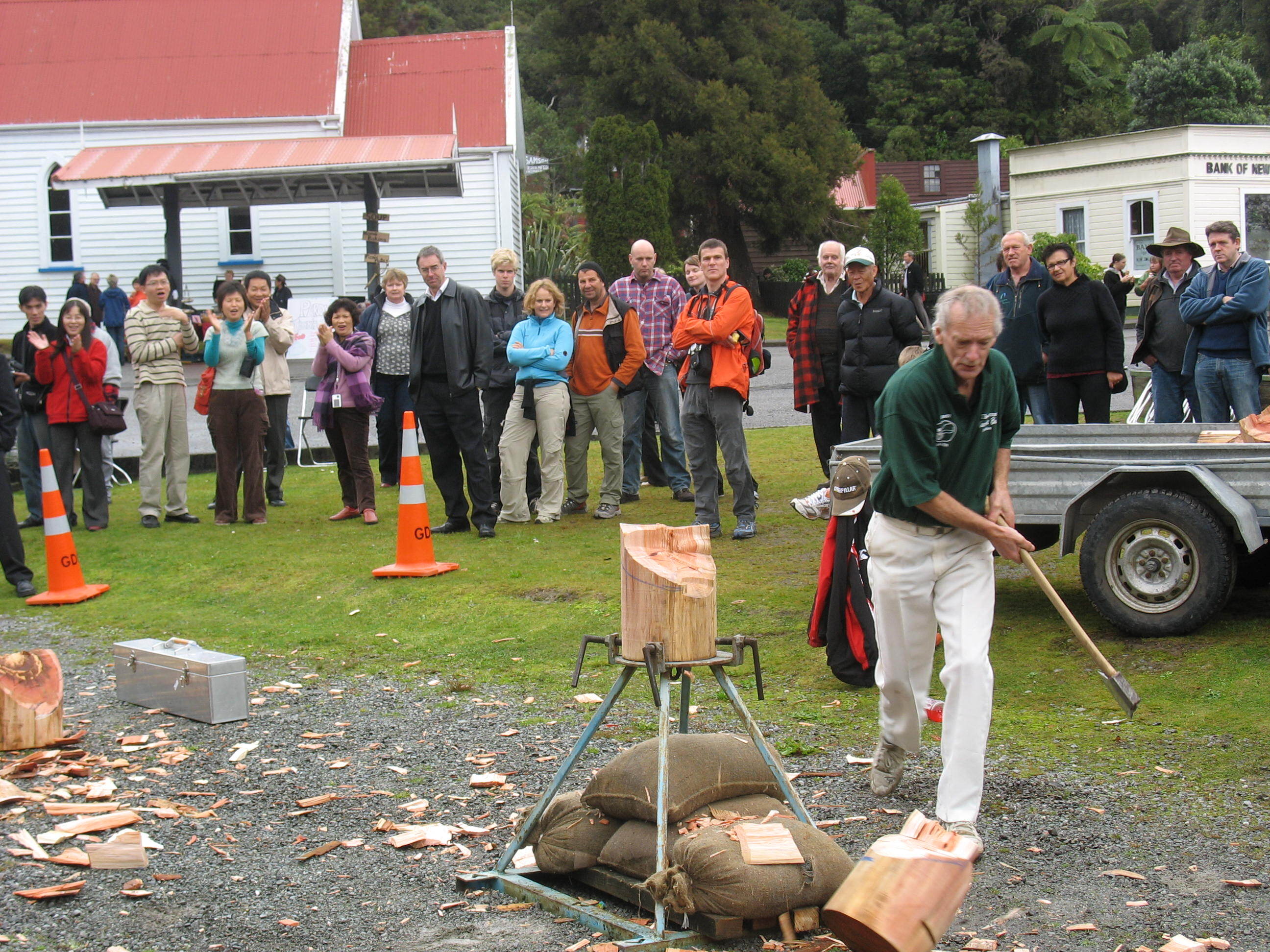
He served 27 years in the Karamea Fire Brigade, earning his Gold Star in 2009, and also worked as an ambulance officer for eleven years. He and May became life members of Coast Buller Timber Sports and the South Axemen’s Centre for their long involvement in woodchopping sports.
Of all his achievements, he is most proud of his family. Since their marriage in 1973, he and May have remained in the house they built in the mid-1970s. Their son James is an electronics engineer, and their daughter Rosalie is a graphic designer and teacher. They now have four granddaughters and enjoy travelling in their caravan whenever possible.
One of his most meaningful community contributions is the full-size bronze sculpture of the Hokioi – the giant eagle of Māori legend – created alongside Chief Te Maia Kahurangi. Inspired by bones found in the Ōpārara caves, the sculpture took three years to complete and became part of the Karamea Estuary Enhancement Project.
Looking back, his life has been shaped by the landscapes of New Zealand, its forests, rivers, wildlife, and communities. From forestry to conservation, history to community service, each chapter has offered challenge, purpose, and discovery. Most importantly, it has been a life lived outdoors, just as he always hoped.
Do you have a story to tell? We'd love to hear from you. Contact us at collegians@scotscollege.school.nz.